Quality and Transparency in Project Work
Quality and transparency are very important in Brot für die Welt’s projects and are key principles that accompany and shape all phases of the project cycle.
What Do Quality and Transparency Mean?
Every year, we take on numerous new projects for funding. To achieve the biggest impact and strengthen trust, we place particular emphasis on quality and transparency.
For us, quality means that projects are carefully planned, implemented and reviewed. In collaboration with our partner organisations, we ensure that measures are effective, needs-based and sustainable during all phases, from analysis to completion. Expert advice, monitoring and clear success criteria ensure the high quality of our work. Findings are continuously incorporated into the further development of our approaches.
Transparency is the basis for trust and cooperation. We document all steps in a traceable manner – from the use of funds to evaluation. Regular reports, on-site visits and independent audits ensure that funding remains open and verifiable. We take consistent and transparent action in the event of difficulties or irregularities.
In this way, our projects make a sustainable contribution to improving living conditions and strengthen the trust of all those involved.
How Is Quality Assurance Carried Out in the Project Cycle?
Our projects follow a clear, proven project cycle with five phases. In each phase, our partner organisations can draw on expert advice to tailor the quality of their work to local needs.
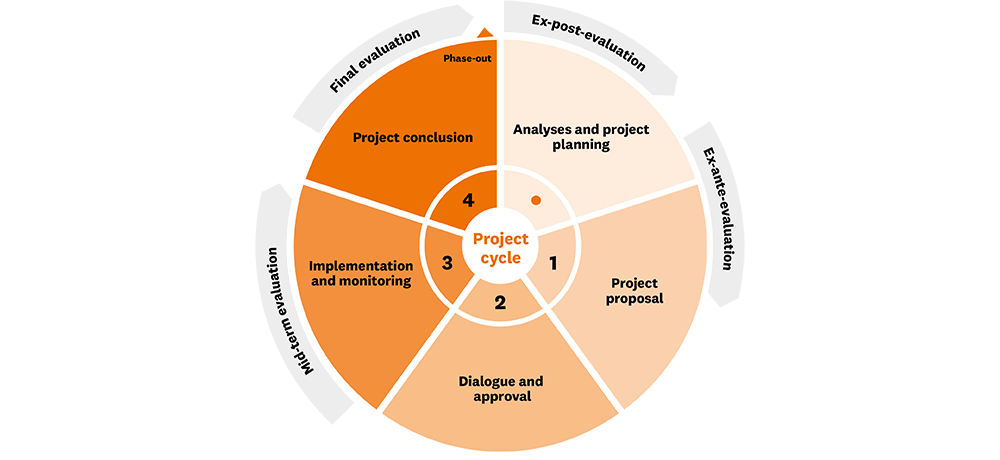
- Phase – Analysis and project planning
We start every collaboration with intensive analysis and planning together with our local partner organisations. This includes problem and context analysis, stakeholder and gender analysis, and the identification of target groups. This thorough preparation forms the foundation for every project idea. - Phase – Project application
Once the project idea is fully developed, the partner organisation submits an application. It describes the main problem, target groups, desired goals, measures, impact and costs. Information about the organisation's own structure and financing is added to the application. - Phase – Partner dialogue and approval
Once the application has been submitted, we jointly review and discuss its feasibility, objectives and outcomes and impacts. Any open questions are clarified and the application is amended if necessary. If the application is approved, it is authorised by the relevant committees. - Phase – Implementation and monitoring
The partner organisation implements the measures, documents progress and reports regularly. Systematic monitoring ensures quality and transparency. We visit projects on site and check that funds are being used correctly. We intervene in the event of irregularities. In addition, project progress is regularly evaluated externally. - Phase – Project completion
Once the measures have been completed, the partner organisation prepares a detailed final and financial report. We review the results, analyse the experiences together with the organisation and use the knowledge to improve future projects.
Technical Terms Explained Briefly
Outcome and impact orientation
In development cooperation, outcome and impact orientation means focusing projects specifically on their long-term effects. At Brot für die Welt, we are committed to ensuring that our projects have a lasting and positive impact on the lives of local people. That is why we systematically measure the impact of our work: when submitting an application, our project partners must already explain how they intend to measure the success of the project and which goals it will achieve. Throughout the course of the project, they observe and document all changes – both positive and negative – that result from the project. This enables them to transparently demonstrate at the end of the project the extent to which the desired goals have been achieved.
Evaluations
Evaluations are thorough analyses that we use to assess the success of our projects. Independent evaluators carry out these assessments on our behalf, using scientific methods, transparent project documents and feedback from those involved. The results provide valuable recommendations for the further development of targeted projects. Together with our partner organisations, we commission numerous evaluations every year to continuously improve the quality and impact of our work.
Donate now Please support us
Hinweis: Die Spendenbeispiele sind symbolisch. Durch Ihre zweckungebundene Spende ermöglichen Sie uns dort zu helfen, wo es am dringendsten ist.
56 € ( Donation example ) For example, a donation of €56 can help fund a hygiene kit for a refugee family.
100 € ( Donation example ) For example, a donation of €100 can provide vegetable seeds for cultivating around 10 fields.
148 € ( Donation example ) For example, a 2,000-litre rainwater tank can be purchased for €148.
Hinweis: Die Spendenbeispiele sind symbolisch. Durch Ihre zweckungebundene Spende ermöglichen Sie uns dort zu helfen, wo es am dringendsten ist.
56 € ( Donation example ) For example, a donation of €56 can help fund a hygiene kit for a refugee family.
100 € ( Donation example ) For example, a donation of €100 can provide vegetable seeds for cultivating around 10 fields.
148 € ( Donation example ) For example, a 2,000-litre rainwater tank can be purchased for €148.